




Irina Maloir
Irina Maloir ( Liège, 1996) est diplômée d’un master en arts visuels et de l’espace en design textile. Constamment attirée par ce qu’il reste, ce qui n’est plus à sa place après usage, elle explore la tension qui réside entre les notions de ressource et de déchet. Sa démarche consiste à interroger et perturber les critères de noblesse, de valeur marchande et de désirabilité de matériaux pauvres ou ordinaires.
Pousser les limites esthétiques, mécaniques et sensorielles de matériaux manufacturés et à usage unique tel que papiers, plaquettes de médicaments, agrafes, capsules de canettes et de bouteilles et surtout de matériaux bruts d’origines animales comme le cheveu, le crin de cheval, le poil (humain) et enfin la laine est au coeur de sa recherche.
C’est d’abord par l’élaboration de matières textiles sensuelles et étrangement irrésistibles, qu’elle s’amuse à susciter une tension chez celui qui regarde entre attraction et répulsion, désir et dégoût. En flirtant avec les notions d’impureté et de tabou, ses interventions plastiques, sculptures et installations, exploitent et révèlent ce que l’humain à tendance à jeter, dissimuler et enfouir.
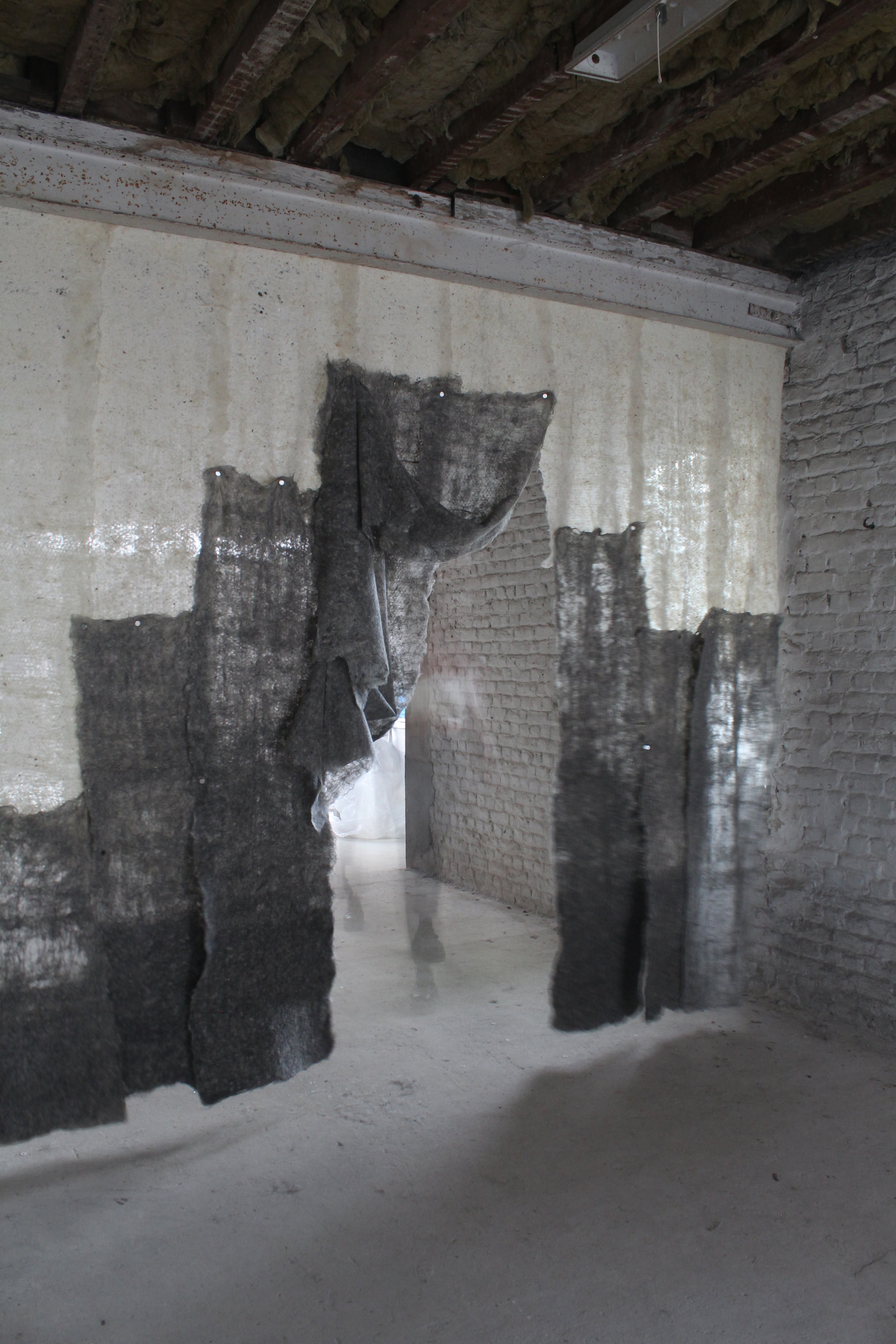
Depuis 2019 elle travaille le feutre de laine, un procédé de fabrication élémentaire et archaïque qui permet de réaliser des matières et forme depuis la toison bruts jusqu’à l’objet en un minimum d’étapes. Elle met au point des voiles de feutre dont la transparence permet de révéler les qualités intrinsèques des différentes laines qu’elle rencontre. Dans ses écrans, parois et œuvres suspendues, cette matière devient support de récits culturels et sensoriels.
Irina Maloir (Liège, 1996) holds a master's degree in visual and spatialarts, specializing in textile design. Constantly drawn to what remains, to whatis no longer in its place after use, she explores the tension between thenotions of resource and waste. Her approach consists of questioning anddisrupting the criteria of nobility, market value and desirability applied toordinary and/or poor materials.
At the heart of her research is the pushing of the aesthetic, mechanical andsensory limits of manufactured, single-use materials such as paper, blisterpacks, staples, can and bottle caps, and above all raw materials of animalorigin such as hair, horsehair, (human) body hair and, finally, wool.
She begins by developing sensual, strangely irresistible textile materials,playing with the tension they provoke in the viewer between attraction andrepulsion, desire and disgust. Flirting with the notions of impurity and taboo,her artistic interventions, sculptures and installations exploit and revealwhat humans tend to throw away, hide and bury.
Since 2019, she has been working with wool felt, an elementary and archaic manufacturing process that makes it possible to create materials and forms, from raw fleece to finishedobject, in a minimum of steps. She develops felt veils whose transparency reveals the intrinsic qualities of the different wools she encounters. In her screens, partitions and suspended works, this material becomes a vehicle for culturaland sensory narratives.
Irina Maloir (Luik, 1996) behaalde een master in visuele en ruimtelijke kunsten, richting textielontwerp.Ze wordt voortdurend aangetrokken door wat overblijft, door wat na gebruik nietmeer op zijn plaats is, en onderzoekt de spanning tussen de begrippen grondstofen afval. In haar werk bevraagt en verstoort ze de criteria van adel,marktwaarde en begeerlijkheid van gewone en/of arme materialen.
Centraal in haar onderzoekstaat het verleggen van de esthetische, mechanische en zintuiglijke grenzen vanindustrieel vervaardigde wegwerpmaterialen zoals papier, medicijnstrips,nietjes, kroonkurken en flesdoppen, en vooral van ruwe materialen van dierlijkeoorsprong zoals haar, paardenhaar, (menselijke) lichaamsbeharing en tot slotwol.
Ze begint met hetontwikkelen van sensuele, vreemd onweerstaanbare textielmaterialen, waarmee zespeels een spanning opwekt bij de toeschouwer tussen aantrekking en afkeer,verlangen en walging. Door te flirten met de begrippen onzuiverheid en taboebenutten en onthullen haar plastische ingrepen, sculpturen en installaties watde mens de neiging heeft weg te gooien, te verbergen en te begraven.
Sinds 2019 werkt ze metwolvilt, een elementair en archaïsch productieproces waarmee materialen envormen kunnen worden gemaakt, van het ruwe vacht tot het object, in een minimumaan stappen. Ze ontwikkelt viltsluiers waarvan de transparantie de intrinsiekeeigenschappen onthult van de verschillende wolsoorten die ze tegenkomt. In haarschermen, wanden en hangende werken wordt deze materie drager van culturele enzintuiglijke verhalen.